Thursday, 26 September 2013

Minor marriage stopped in Chennai
Pramila Krishnan
Chennai, September 26: Child marriage happens right in our city. A fourteen year old, class nine girl was rescued by the Kanchipuram child welfare committee from a marriage hall at OMR on Tuesday night. The groom S.Vijaykumar(25) was a real-estate contractor. He wanted to marry the girl in her quarterly exam leave since his father was not keeping well and wanted to witness his marriage. 

Based on phone call received in the Childline helpline (1098) the team comprised of tahsildar, district social welfare officer, police officials and the child welfare committee members rushed to the marriage hall and called off the marriage. According to the Kanchipuram social welfare department almost 25 marriages were stopped in the last three years including eight marriages this year so far. 

Speaking to me, CWC member I.Zaheeruddin Mohammed said, “When we arrived at the marriage hall, families of bride and groom and their relatives were frustrated and tried to convince us. We told them that it is illegal to perform underage marriage, they said the groom’s father was sick and wished to see his marriage. And both families were close relatives” He added when the team stoutly rejected all their pleas, the families agreed to stop the marriage. 

The officials made the parents to give a letter in writing that they would not get the girl married before she attains 18 years. District child protection officer S.Dhanasekara Pandian said that several awareness programmes were arranged in anganwadi centers and other public places on child marriages. School children were encouraged to alert about child marriages, he said.

Friday, 20 September 2013

வெங்காயம்; புன்னகை; கண்ணீர்

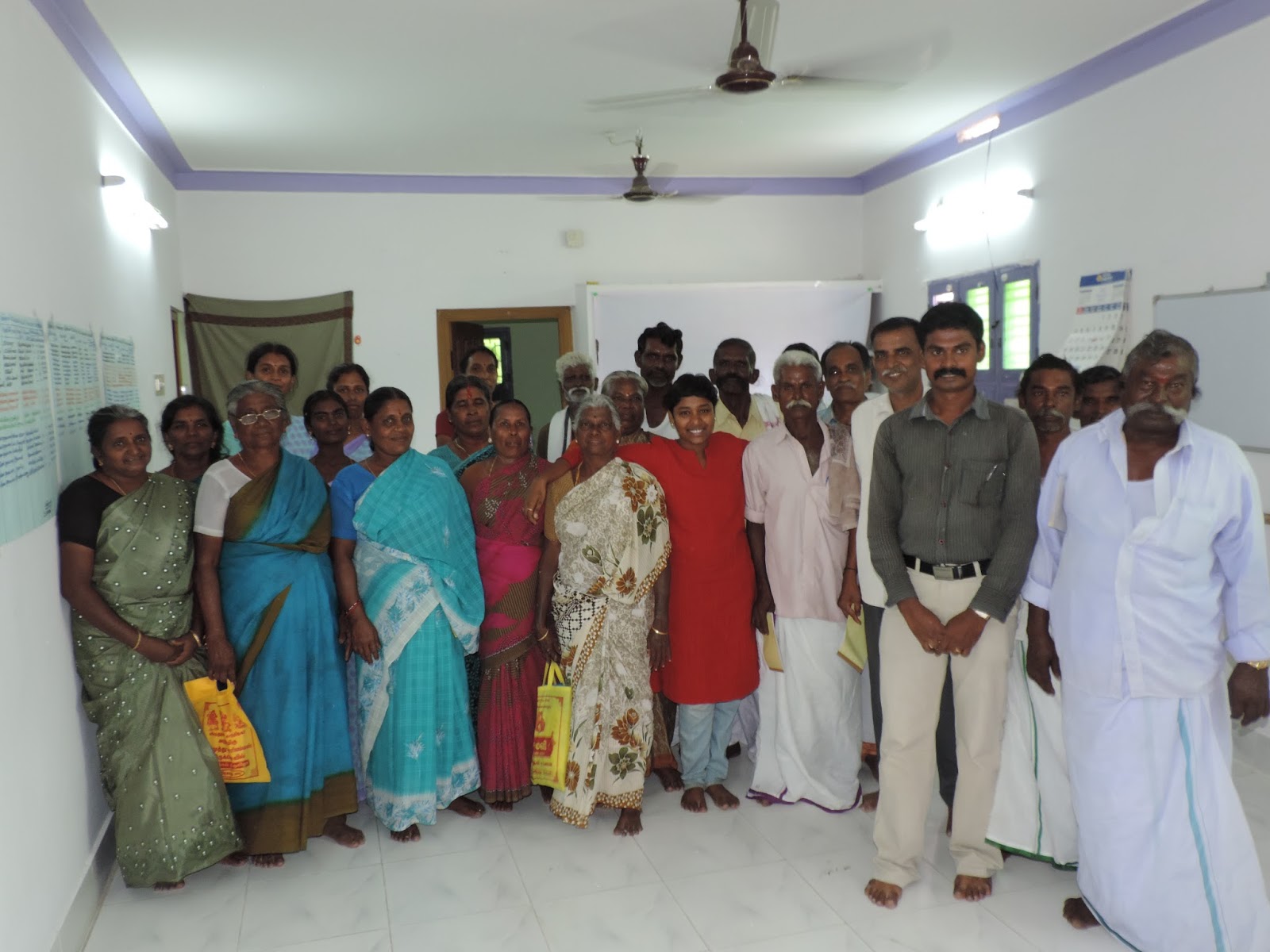
MSSRF (M S Swaminathan Research Foundation) மூலமாக ஒரு   பத்திரிக்கையாளர்களுக்கு கருத்தரங்கு நடைபெற்றது . அதன் முடிவில் கரசனுர் என்ற ஒரு கிராமத்திற்குக்  கூடிச் சென்றனர் . விழுப் புரம் மாவட்டத்தில்  உள்ள இந்த கிராமத்தில் MSSRF கடந்த 2 வருடங்களாக வேலை செய்து வருகிறது. ஏற்றுமதி தரம்  வாய்ந்த வெங்காயங்களை இங்குள்ள விவசாயிகள் பயிரிட்டு முன்றே மாதத்தில் சுமார் ரூ.2 லட்சம் இரண்டு ஏக்கர் நிலத்தில் சம்பாரிப்பதாகத்  தெரிவித்தனர்." எங்களின் வெங்காயம் சிங்கபூர்  மற்றும் மலேசியாவிற்குச் செல்கிறது . அங்கே சூப் செய்ய இதைப்  பயன் படுத்துகிறார்கள்," என்றனர் .

கூட் டத்தின் முடிவில் அவர்களிடம், வருமானம் நல்லா  கிடைக்கிறது, வாழக்கை நிலையும் மாறி இருக்கிறது. உங்களில் எத்தனை பேர் உங்கள் குழந்தைகளை விவசாயியாக இருக்க அனுமதிப்பீர்கள் என்று கேட்டேன். சுமார் 50 விவசாயிகள் இருந்த அந்த கூடத்தில் ஒருவர் கூட கை தூக்கவில்லை. ஏன் என்ற போது, "நங்கள் படும் பாடு போதும். எங்கள் பிள்ளைகள் கஷ்டப்பட வேண்டாம்," என்றனர். இரண்டு பெற்றோர் அவர்களின் பிள்ளைகள் ஆர்வமுடன் விவசாயம் செய்ய ஆசைப்பட்டனர் தாங்கள் தடுத்து இன்ஜினியரிங் கல்லூரியில் சேரத்துள்ளதாகத் தெரிவித்தனர்.                            

Sunday, 8 September 2013

People's power won in Perambakkam

Pramila Krishnan
Perambakkam, September 8: A special gram sabha held in Perambakkam in Kancheepuram district on Saturday was an example of people’s power. Residents of the little town boycotted the August 15 Independence Day gram sabha since officials aborted the greenhouse project in their neighbourhood due to pressure from local politicians. The district administration organised a special gram sabha and approved the housing project much to the glee of the residents.
Officials attended special gram sabha
on Saturday in Peranambakkam


Speaking to me, Perambakkam panchayat president Lavanya Mahendran (26) said the officials did not bother to listen to the people who were waiting for the funds to construct their houses. “Only when we boycotted the gram sabha did they understand and budged. They attended the gram sabha and promised to fulfil our demands,” she said. She added that the entire village was supportive in helping the poor beneficiaries who were earlier informed by the officials that they would not get funds.

Talking about other resolutions passed in the special gram sabha, vice president of the Perambakkam panchayat S. Kumar (29) said, “A private firm has encroached some four acres of promoboke land in our village and refused to vacate even after we issued a notice. Now we have asked the district administration to take over the lands from the private hands and surrender them to us.” He said the panchayat members have also placed a proposal to build concrete roads in the village. 

A resident of Perambakkam panchayat K. Mahalingam said young leaders of the panchayat took the initiative to refurbish the panchayat office, which had been abandoned for the last two decades. “They also run three free tuition centres for poor students. Though Perambakkam is a reserved panchayat for Dalits, these young Dalit  leaders have won the hearts of people from different communities,” he noted.

Thursday, 5 September 2013

Sanitation is my religion: International sanitation expert Bindeshwar Pathak

Chennai, September 5: Bindeshwar Pathak (70), social reformer, native of Bihar, fights the caste system in India and particularly discrimination against manual scavengers by the upper class by introducing green toilets. Born a Brahmin, Pathak lived with scavengers and founded Sulab sanitation and social reform movement in Delhi in 1970, and has now successfully constructed hundreds of toilet complexes which are being used by nearly 10 million Indians.He spoke to me after being awarded the 'lifetime achievement award' by the Rotary Club of Madras in the city last Tuesday.


Question: What are the advantages of Sulab toilet?


They are hygienically and technically appropriate. Ours is an affordable system and doesn't pollute the ground water. Sulab model is a clean toilet which can be fixed in a house and there will be no complaints of mosquito or foul smell. Apart from this, sulab converts the waste into compost, which could be used in the fields and house gardens. Our model has been acknowledged by the UNDP in the human development report.

Question: How about your presence in Tamil Nadu?
We are spreading it as much as we can. In Tamil Nadu there are small groups which have taken up projects to set up toilet complexes. Sulab toilet in Chennai airport is working well. Our eco-friendly toilet model has not been patented simply because we want many more to benefit.

Question: How far the Sulab projects have empowered the untouchables?

Instead of talking about figures, I am telling you a tale of two towns in Rajasthan - Alwar and Tonk - where the upper caste and lower caste people earlier involved in manual scavenging, dine together and live without any discrimination. Recently, I was informed that many upper caste families have shown interest in marrying lower caste women. We first make arrangements to bring people from different castes to have a cup of tea  together and then have food together. Sanitation is my religion. Ours is a protest   movement against caste hierarchy in Hinduism. Instead of raising our hands against them, we supplicate and win their hearts. Gandhigiri is our weapon.

Question: Why will utilising biogas-linked toilet complexes remain a far-fetched dream in India?

We have to stop feeling shy and discuss sanitation. Our toilet museum in Delhi was set up in 1994. Scores of people visit the museum and are thrilled about the toilets different civilisations used in the early ages. The government and voluntary organisations have to come forward to promote its usage and explain the benefits of biogas toilets. Apart from India, we have installed green toilets in Kabul in Afghanistan and now got invitations to set up the same in African cities. All this because people are willing to talk about toilets without feeling shy.


To know more about Bindeshwar Pathak: http://www.sulabhinternational.org/content/dr-bindeshwar-pathak


Sunday, 1 September 2013

Gandhi to rescue our rupee

  • Why should we depend on MNCs to eat potato chips and gulp soft drinks?
  • Gandhian economics is not bullock cart economics 

Pramila Krishnan
Chennai, September1:  Mahatma Gandhi gave solutions to enhance the economic development of India, but we have failed to implement his models in a big way, says Gandhian, A. Annamalai, director of the Gandhian study centre in Chennai. Annamalai spoke to me about how economic policies framed without following Gandhian values have failed, and what are the immediate measures that can save us from this abysmal situation.

Question:  How can Gandhian economics shake us out of the present economic slowdown?

Annamalai: Gandhian economics is the best policy to develop India in a sustainable manner. For example, we celebrate allopathy and call our native medicine as alternative medicine; the same thing has happened with our economics now. Instead of strengthening our foothold in agriculture as Gandhi asked us, we invited multinational companies (MNC) to invest in every field in India. A foreign firm sets up a company only to earn more or use the cheap labour available here. If his profits plummet, he simply shuts up without bothering about the workers and consumers. So we have to understand that foreign investment happens because MNCs want to flourish and are not bothered about the welfare of Indians. As far as possible, we should have decentralised production and distribution for all goods.

MNCs recruit scores of educated youth every year. Isn’t this progress?

Annamalai: We have to understand that MNCs take a fresh load of workers every year. But do they expand their units? They get rid of workers and take new people every year. This creates an illusion that MNCs give employment to the masses. If the recruitment had really benefited us, why should the unemployment index soar in the country? Employment by MNCs has really benefited only the creamy layer of society.

Are Gandhian economics suitable for this era of consumerism?

Annamalai: Most people relate Gandhian economics with bullock cart economics and think it suitable only for villages. Gandhi also preached distribution of wealth. If you think a car is an essential need, it should be made available for the last citizen of this country. Ours is an agro-based economy. Unless we invest and improve agriculture, we won’t be able to see growth and empowerment of the common man. Privatisation and globalisation are not the roadmaps for Vallarasu India (superpower India). Why should we depend on MNCs to eat potato chips and gulp soft drinks? Can’t we produce and sell them locally? Localisation and swadeshi consumerism should be encouraged to free us from MNCs and fight economic slowdown.

Wednesday, 28 August 2013

From my bookshelf

Letters from prison-Captive Imaginations-Varavara Rao

Page number 12: 

Wait for me,, and I’ll come back,
Wait and I’ll come.
Wait through autumn’s yellow rains
And its tedium
Steel your heart and do not grieve,
Wait through winter’s haze,
Wait through wind and the raging strom,
Wait through summer’s blaze.
Wait when other’s wait no more,
When my letter stop,
Wait with hope that never wanes,
Wait and don’t give up.

Wait for me and I’ll come back;
Patience, dear one, learn.
Turn away from those who say
That I’ll not return.
Let my son and mother weep
Tears of sorrow,
Let friends insist that it’s time,
That you must forget.
Do not listen to their kind
Words of sympathy,
Do not join them if they drink
To my memory.
Wait for me! Let those who don’t-
Once I’m back with you-
Let them say that it was luck
That had seen us through.
You and I alone will know
That I safely came
Spitting every kind of death,
Through that lethal flame,
Just because you learned to wait
Staunchly, stubbornly,
And like no one else on earth,
Waited,love, for me.

Page number 20: 

When children play for long under trees, one often hears mothers affectionately reprimanding them: ‘what treasure have you buried under the tree? Often, it is said out of irritation if the girls are not helping with household chores. In the case of boys, it is because they are not on time for their meals. As for me, call it a fond illusion, but I seem to sense my mother’s living presence in the trees outside my window, watching me from the open sky, the mango trees, her outstretched arms.

Providing new tastes again and again
My mother’s hands are like honey.
Tiding me her story time and again
My mother’s voice is a melody.
Drawing me close
Those hands turn into the vision of spring-
The koel’s song
The rasa’s taste
The cool shade

Page number 21: 

In the years of 1986 and ’87 in summer, I used to read mostly under the shade of those trees. The mango tree outside my windows fell during the gale of 21 February 1988. Then I truly felt as if mother earth had lost one of her arms. Such a big tree uprooted so easily! As the hailstones pelted down, as the strong wind blew and the rain fell, the slender jamun plant bound to a bamboo moved restlessly, but the string did not snap. The guava tree rocked back and forth wildly, as if possessed. Only the stalk was left of the rose bud that would have bloomed in a few days. The petals fell scattered around the plant.

As I said, not all the trees in this courtyard were planted by human beings. Some of them were planted by birds. What was strange was, that beside each tree that grew thus because of birds, another kind of tree grew alongside. In jasmine bed there was an almond growing, in another, a sopanut tree, a kaumaga, not to speak of the rela. And in the rubbish heap in one corner, there grew a neem, a jasmine, a tamarind and a rela.

Page number 22: 

During three summers that blazed down on us, tending the trees we had planted was like caring for infants. With joy, I watched the green tip of the jackfruit grow inch by inch, picked off the worm eaten leaves of the jamun, and looked at the days of my imprisonment against them. Watering the plants on summer evenings, talking to the birds that fearlessly join me and gracefully drink the water I pour, a thought flashes through my mind brining a feeling of shyness in its train: this love of plants I have learnt so late is one I must cherish privately. A love which must never be shown in public except as the proverbial three flowers  that bear six fruits.

Page number 24:

One morning a rose bush puts forth a bud. Remember when you planted that cutting, wiping desire for a new life to take root? And whenever a heart is wounded and stitched together again, a new dawn seems to be twittering to life.
As I write of that experience it is if the pollen of those wounds bursts forth from my fingertips. Whether in humiliation, or amidst felicitations, in suffering of in joy, the spirit of these trees as I have understood it in these last three years has infused my tastes and values.

Page number 26: 

From bare stalks haunted by
Memories of fallen flowers
Fresh shoots appear.
Hidden in the leaves of the present
 The invisible future
Koel-like, ours forth
The pain-drenched sweetness
Off the past.

Page number 29: 

Surely it can’t be pleasant thing for birds, as symbols of freedom, to be in jail? And yet how can I claim that they are not cheerful and contended? Whenever I see pigeons inside the jail I wonder. .. And the sight of the these pigeons reminds me , not of the people forgotten, but of bonds that must be forgotten; not of past lives but of the past trapped in the present.

Page number 30:

But then, I don’t quite understand how these surroundings have grown so congenial ovr the last two and a half years and why there are pigeons everywhere now. In the trees, in courtyard in front of my cell, on the barrack ventilators, before the staff kitchen, near the water, above the ledges of the barracks behind my cell- they are everywhere, like blue-grey clouds that have come down from the sky. The sounds- their rustling against the tin windows shades, pecking at each other, the fluttering of wings-from a background to the silence of my solitary existence. They have grown so familiar that I have stopped going to the back of my cell fearing that I may disturb them when I walk briskly in the evening. Sometimes I go there stepping softly, barefoot, to watch them. Even at night, as I place inside my cell, I do so in perfect silence, for fear of disturbing the pair of pigeons nesting in the ventilator.
My days and night slip by, spent in these lovely pigeonholes, and as I drift into sleep.

Page number 33:

In a culture of inequality, the value called love is always the first casualty. You don’t change the system merely by shedding tears of sympathy. Nor do you change it by patronizing, reacting or commenting. Isn’t that why Marx said that you cannot change society unless you become part of the change?

Page number 36:

I have no great fondness for cats, nor do I dislike them. But, as the curds in our mess grew continuously less, I suspected that it must be because someone was adding more water to the milk, or a smaller amount of milk was being set aside for curds, or someone was drinking it up. We could not discover the exact cause and carried out all kinds of inquiries. At last we discovered that one of the detainees, out of sheer love for his adopted child, was keeping the cupboard unbolted and allowing the cat to have its fill of curds. The man himself was not particularly used to eating curds.

Page number 44:

Everything that I read is absorbed instantly like water by dry earth. Throughout the day I read newspapers and journals-front to back, without missing a single link. But then, there is no one with whom I can share my opinions or discuss what I have read. A full three years have passed since I have glanced through any magazine of revolutionary nature. Magazines with such writing must have blossomed in hundreds. What is the use of having eyes if one is not able to read them?
In the newspapers I read, I find nothing about class struggle, or struggles for democratic rights or civil liberties; nothing about tribal revolts, dalit and women’s liberation movements or environmental movements. There is no word in these newspapers of revolutionary organizations, their journals, and how these organizations are reacting to caste and communal clashes, and a host of other issues. Not a single ray of light penetrates the pervasive gloom.

Page number 57:

Censorship of letters is not an inconvenience that is associated only with jails. I have lived with it for the last 23 years. The heated debates about the postal bill and the tapping of telephones, and the mutual recriminations between the Congress and other parties, are amusing to a communist who has been used to this from the very birth of his party. This discussion of an open secret seems to me like Brahminical sophistry.

The difference between letters being censored while in jail and while outside is that, out there, you cannot claim they are being censored although you know the truth. Besides, outside jail, we seal our letters and then post them. They are delivered sealed (unless the one who reads then is too lazy to seal them again). In jail, the letters are handed over without the pretence of sealing them. Letters that arrive are torn open, censored, stamped with the jail seal and signed by the concerned official, before being delivered to the addressee.

Our loves, friendships, bonds, tenderness, ideas, innermost feelings, passions, dreams, truths – the most private and secret chambers of our hearts are laid mercilessly open by the surgeon’s knife. The gaze of strangers and aliens falls on them and they are returned to us, unstitched. What stubborn hearts these, that even in such conditions they continue to throb with feeling!

When I was first arrested in 1973, the mere thought  that someone would read my letter would paralyse my pen.

Page number 62:

The people to whom I write and who write back to me are all immersed either in public service or in literary and cultural movements. I tend to forget what a bad correspondent I used to be when I was outside, similarly preoccupied. Now that I sit ready with my pen poised on paper, I am quick to fall victim to impatience, misunderstanding or anxieties because those whom I write to don’t write back. Even those whom I write to don’t write back. Even those who are not busy expect letters from me, don’t reply. When they try to write, their hearts but do not reply. When they try to write, their hearts weigh heavily on their pens! And so they expect me to continue to write without hoping for a reply!

Page number 63: 

Although in my political activity I never compromised or bowed before anyone, for these letters, from the minute I expect them to arrive, I seem to turn into beggar-hands stretched. 

Saturday, 24 August 2013

 முதியவர்கள் தங்களின்  உரிமைகளுக்காக போராடத் தயார் 


இன்று விருதுநகரில் முதியவர்களுக்கான முதியவர்களின் கூட்டமைப்பு சார்பில் ஏற்பாடு செய்திருந்த கூட்டத்தில் கலந்து கொண்டேன். மிக நெகிழ்ச்சியான சந்திப்பு. ஒரு 20 தலைவர்கள் முதியவர்களின் முக்கியமான பிரச்சனைகளைப் பற்றி பேசினார்கள். முதலாவதாக, அவர்கள் எதிர்பார்ப்பது, அன்பு, மரியாதை, அவர்களையும் குடும்பம் மற்றும் சமுதாயத்தில் அவர்களின் பங்கேற்பு என சொன்னார்கள். 
ராமசாமி தாத்தா ஒரு MGR பாடல் பாடினார்.

முதியவர்களுடன் ஒரு group photo
2010ல், தலைகூத்தல் என்ற பெயரில் நிறைய வயதானவர்கள் அவர்களின் குடும்பதினர்களால் கொல்லப்பட்டனர். அது பற்றிய நான் செய்தி வெளியிட, அது பலதரப்பில் விவாதங்களை ஏற்படுத்தியது. இரண்டு வருடங்களுக்குப் பிறகு, நான் பார்க்கும் முதியவர்களின் சிந்தனை என்னை வியக்கவைத்தது. அவர்கள் அவர்களுக்க்கப் போராட முன்வந்துள்ளனர். அவர்கள் மாவட்ட கலெக்டரை சந்தித்து அவர்களின் கோரிக்கைகளை வைப்பதாக கூறினர். இந்த முதியவர்களிடம் தன்நம்பிகை  இருந்தது. இவர்கள் பயணிக்கத் தயாராகி விட்டனர். தற்போது 109 குழுக்களில் 1,500க்கும் மேற்பட்ட முதியவர்கள் இந்த அமைப்பின் கீழ் ஒன்று சேர்ந்துள்ளனர்.